Catholic Church
The Hunchback of Notre DameThe Catholic Church appears as a religious institution, a source of political and legal authority, and the force whose changing place in society is written into medieval architecture. Its churches offer refuge within a fragmented system of justice, but they also stand at the center of conflicts over jurisdiction and punishment. The book’s larger historical argument traces a shift from ecclesiastical control of cultural expression toward popular art and, eventually, the printed word.
Authority and Architecture
The Church’s power is given material form in the medieval cathedral. Notre-Dame Cathedral is described as a collective work in which the imagination of individual craftsmen is ordered within a larger artistic whole. Its façade brings together three arched portals, twenty-eight royal niches, a central rose window with two smaller windows beside it, a gallery of trefoil arches, and twin towers. The variety of sculpture and carving belongs, in the narrator’s account, to an integrated composition: a public record made by a people and an age, not merely the product of a single designer.
Architecture also registers the Church’s changing political position. The Romanesque period is associated with theocracy, unity, fixed symbolism, and the primacy of the priest; its forms express an authoritative religious order. After the Crusades, the Gothic period is linked to popular movements and greater liberty. As the cathedral becomes a shared work of the community and the artist, it is no longer described as the Church’s exclusive possession. The contrast is not simply between two styles: it marks a change in who can give visible form to collective thought.
Notre-Dame as Sacred Text
The cathedral carries religious meaning through images and architectural details that invite interpretation. Claude Frollo studies its sculptures and treats the façade as a coded text, attending to the figures of the wise and foolish virgins and to a raven whose gaze, he believes, points toward a hidden secret. He also attributes significance to the symbolic door and to statues associated with Saint Christopher. His explanations present the church as an object of learning as well as devotion, although the claims belong to his interpretive practice rather than to any settled institutional doctrine.
The narrator emphasizes that the Church is loved in different ways by Claude and Quasimodo. Quasimodo’s attachment is to the cathedral’s physical beauty, scale, and harmonies; Claude’s is to its myths, symbols, and unresolved meanings. The contrast joins embodied experience to learned interpretation, while making Notre-Dame both a religious building and a central object of the novel’s inquiry into how meaning is preserved in stone.
Jurisdiction and Sanctuary
The Catholic Church’s institutional authority operates within a divided civic landscape. In the fifteenth-century arrangement of Paris, the island belonged to the bishop, while the right bank was associated with the provost of the merchants and the left bank with the Rector. The royal provost of Paris exercised authority over the wider city. Churches and ecclesiastical institutions therefore existed alongside other jurisdictions rather than above a single, unified legal system. The privileges of scholars at the University of Paris further illustrate how competing authorities could shape where offenses were tried and where punishments were carried out.
Churches also possessed the right of asylum. Once a fugitive entered a recognized refuge, the account says, the person was protected; leaving it meant returning to the danger of secular punishment. This protection could become confinement: condemned people might remain for years within a cloister, palace enclosure, or church precinct, unable to leave safely. In rare cases, a formal decree could override asylum, and the narrative notes that armed violation of a sanctuary carried serious consequences. The institution thus offered protection within a punitive system without abolishing that system’s reach.
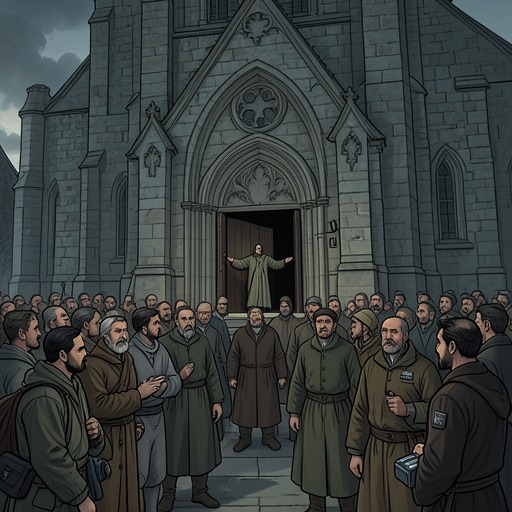
The account of a condemned woman makes the boundary between ecclesiastical space and public justice especially visible. Her sentence requires a public act before Notre-Dame Cathedral and then directs her onward to execution at Place de Grève. At the cathedral’s opened portal, a darkened nave, candles at the altar, a cross, and chanting frame the scene as a religious ceremony, while the crowd and escort belong to the public enforcement of a sentence. The episode places sacred ritual beside state punishment without making the two authorities identical.
Change, Conflict, and the Printed Word
The book presents the printing press as a challenge to the Church’s former command of intellectual life. In Claude’s phrase as interpreted by the narrator, the fear is that one power will succeed another: the printed word may displace the pulpit and manuscript, and human thought may circulate beyond the sanctuary’s control. The argument extends beyond a struggle between technologies. Architecture had served as a durable public medium for religious symbols and human ideas; print offers a new means of expression that can travel and alter opinion.
The account connects this shift to religious division. It argues that without printing, reform might have remained a schism, whereas the press helped turn it into a revolution, and names Gutenberg as a precursor to Luther. As the Gothic tradition fades, architecture is said to lose its former expressive authority and to become increasingly dependent on imitation. This is a historical interpretation of cultural change, not a claim that the Church simply disappears: rather, its once-dominant position in the production and transmission of meaning is challenged.
The cathedral’s physical alterations provide a parallel account of change. The narrator assigns damage not only to time but especially to human interventions. Statues were removed and niches left empty; a new arch and heavy door altered the central portal; the ancient Gothic altar gave way to a marble sarcophagus under the request of Louis XIII and the action of Louis XIV; colored windows were replaced with pale panes; and an architect removed a small bell tower in 1787. These examples distinguish religious authority from the later choices of rulers and architects that reshaped a church’s fabric.
The Church in the Novel’s Social Order
The Catholic Church is neither only a spiritual ideal nor merely one institution among others. Its buildings embody sacred authority and collective memory, while its privileges create a practical refuge from harsher jurisdictions. Those protections remain conditional, and the surrounding narrative repeatedly places religious space beside public judgment, royal power, and civic enforcement. The Church’s significance lies partly in that tension: it can shelter the pursued, yet it cannot make the wider structure of punishment and authority vanish.
Its architectural legacy also carries an argument about cultural ownership. The transition from Romanesque forms associated with ecclesiastical unity to Gothic forms associated with popular participation parallels the movement from the priest’s authority toward the artist and the community. The cathedral therefore records both the Church’s historical centrality and the gradual loss of its monopoly over public expression. Stone preserves the institution’s power, but its changing forms also register the people and artists who came to share that power.